Food is Dead
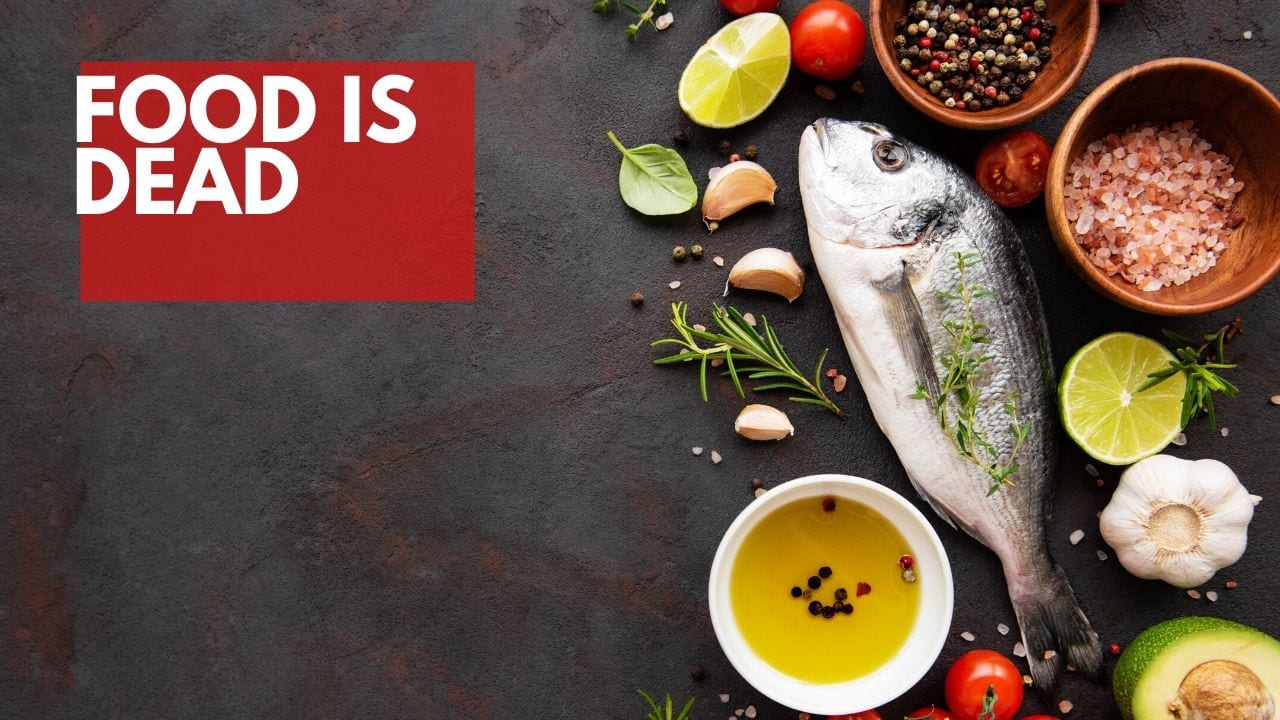
Let me start by saying something controversial: there is no such thing as a “healthy meal,” not really. I guess you could eat a very healthy live animal and that would be a healthy meal. But I don’t see that happening often. Food is not “healthy.” Food is more or less nutritious, food is more or less calorie-dense, and food is more or less tasty. But let’s be real: most of the food we eat is dead or dying. In the best case, the food you eat was alive moments ago, (oysters anyone?) however in most cases your food has passed through several industrial processes that stripped its original glorious biology -think Pop Tarts. This might seem like an annoying linguistic distinction that only a nerd cares about. And it most definitely is, but hey! hold on, there is a useful point to be made: the thing that is healthy or unhealthy is you, not your food. Your health is your responsibility, and yours alone. A snickers bar after lunch is not going to make you unhealthy. But a daily Snickers bar after lunch might. A Snickers bar on Monday and then a Coke on Tuesday, plus those delicious donuts Janice from accounting brought to the meeting on Wednesday (because she does not give a fuck), that bag of chips that somehow made its way down your gullet on Thursday afternoon while you were rushing to meet that deadline, and finally that half of a pizza Friday night, plus the tortilla chips and pork belly tacos you ate after you got drunk on Saturday--all this combined WILL make you unhealthy. Repeated actions are what makes you unhealthy; it is your habitual behaviors that improve or harm your health. But ice cream is not “unhealthy” or “healthy.” As matter of fact, that Saturday ice cream you always have with your kids might be the best habit you have. If that Saturday ice cream is what allows you to eat more nutritious and balanced meals consistently the rest of the week, if it allows you to avoid all that junk that Janice keeps bringing to Wednesday’s meetings and the Friday pizza and beer binge, and if it allows you to spend some quality time with your kids, that Saturday ice cream (despite being full of sugar) is totally making you better and healthier in the long term. Enjoy!
Renouncing to the idea of healthy food is very inconvenient though. It is so much easier just to go to Whole Foods, or Trader Joe’s and buy all the shit that says healthy on the package than it is to actually decide for yourself what you should eat and why. Thinking is a fucking pain. The label “healthy” allows us to buy that delicious protein bar without having to make an informed decision about whether it is actually what our body needs. It lets us be happily ignorant. The New York Times Magazine published an article this week describing how inaccurate parents’ estimations of the sugar in their children’s food are. That implies of course that their estimation of their own food is equally off. And this just shows that we mostly don’t know very well what we are doing when it comes to food, and so we leave it to the advertisers to decide for us. That’s too bad because the market wants you to buy, they don’t care about your health -no moral judgement here. Remember: mentol cigarrettes were once advertised as good for your throat.
What we ultimate want is for you to educate yourself so that your choices are wise and well-informed, so that you are in control instead of the slogans and supermarkets. (“All natural, 100% vegan low-fat gluten-free home-schooled fried chicken, now with whole grains and no high-fructose corn syrup!”) There is a lot to learn and a lot of misinformation and confusion out there (i.e. the Interwebs). But let’s start with something simple. Do this challenge for a week: just try to track how much sugar you are consuming and see if you are staying under the FDA’s recommended 50g of added sugar per day. Remember three things: 1) if it comes in a package it usually has sugar (so READ THE LABEL), 2) if you go to a restaurant it usually has sugar too, and 3) anything that ends with -ose, or has the words syrup or gum in it is just sugar! It’s all the same to your body.
Recommended Reading and Film
That Sugar Film: as many critics have pointed out this movie does not have scientific validity, to be fair it does not claim to have it. But it is certainly an entertaining experiment, and can help you be more aware of what you are doing.
The Case Against Sugar. This is for nerds. If you like History of Science and crime novels you are in for a treat. Taubes makes a rock solid--and controversial--case against sugar. There are plenty of critics of this book, but do yourself a favor and read it and decide for yourself. (Just like you’ll read the labels of your protein bars this week…)