How to get the benefits of meditation without sitting for hours like a weirdo
This is me on a regular day: I stack a pair of 45-lb plates and sit on them in a half-lotus position. Then I stare at whatever is in front of me for fifteen to twenty minutes. I just sit and stare … like a fucking weirdo. Sometimes I do this in the morning, sometimes in the middle of the day, sometimes before bed. Sometimes I do this in the backyard of the gym where I coach crossfit. This gym is located in an industrial zone with no grass nearby. That means the backyard is where all the dogs that visit the gym poop. So when I sit there in a half-lotus position to stare at something like a weirdo I am surrounded by an archipelago of turds. It is quite a scene. In the lot next door the workers who are building the a new factory listen to loud-as-fuck Latin music. Usually somebody is dying because of their lover’s betrayal. Still, I sit there, staring, like a weirdo.
Strangely enough, this is one of the most productive and important moments of my day. In case you haven’t figured it out, I am meditating. I am a big proponent of meditation. In my personal experience and that of many of my clients, I see all the benefits commonly associated with this practice. In all reality you don’t really need lots of research to prove that meditation is useful. To understand how powerful it can be you just need to be a human that can chill at times and a basic understanding of physiology and the autonomic system. (If you need the research though start here.) Sadly, media and mediocre practitioners have done a bad job at teaching what meditation really is, so for many people, it just feels like a foreign pseudo-religious practice --in other words: hippy shit. It is not, nor it is esoteric. Meditation is the bomb.
However, I also think meditation is not the only way into all the benefits that this practice produces. I believe that even though everybody can meditate and benefit from it, meditation is not for everybody. The purpose of this post is to provide some clarity about meditation and give you some ideas on how to use this practice or something analogous to better your life. Hang on to your staches, this will be a wild ride.
Functional Definition of Meditation
With meditation undoubtedly comes to mind the word mindfulness. Both words are greatly overused nowadays and they smell like yoga studios: sweaty incense. Let me try to sweep that odor away. Let’s start with mindfulness. You may already have the sense that part of mindfulness is mindful awareness: the capacity of being present and intentional at whatever is that you are doing. So you know, when you are talking with somebody and at the same time thinking: “Are we done yet? I don’t care about your children. What am I having for dinner tonight?” Not very mindfully aware. Mindfulness itself is a broader cultural construct that includes multiple ancient traditions, and especially the interpretation of those traditions by white people. If you want to get a good idea of this concept check out this document (just the first section). For us, sticking with the idea of mindful awareness is enough, so we just mean: “get off your fucking phone, Juan!” and be ready to repeat in your own words what the person in front of you is saying.
Now, meditation is a practice that fosters the skills needed to have more mindful awareness in your life. Imagine you could just focus on your work for 45 minutes straight without checking your Instagram feed every other minute. Or imagine you did not have to follow the train of thought created by your mind every time you were worried. (In Spanish, we call this worrying imagination La Loca de la Casa: the crazy of the house. Most of us believe everything La Loca is saying and follow her for hours. When you have the skill to be more mindfully aware of your own thoughts you can see La Loca for what she is and not go with her.) Or finally, imagine you could focus all your attention on the sensation of your hamstrings as you squat. Imagine you can do that over and over again during your training for every movement. All of these are what meditation can help you with.
Meditation Skills
As you can infer, meditation can be expanded to be much more than just sitting in a poop garden staring like a weirdo. Although that is a time-tested way of doing it, obvi. But let’s refine our definition a little more so that we can get more specific. First, let’s talk about the skills that meditation develops:
▶ Concentration power. This is the ability to keep your conscious attention willfully on a given task during a period of time. Two things matter here. This is a willful and a conscious effort. This is not the soft focus of a state of flow. It is not an automatic focus. Quite the opposite: it requires patience and work.
▶ Sensory Clarity. Can you consciously tune out the loud sounds of the ranchera in the lot next door? Can you focus all your hearing power to all the other sounds instead? Can you train in a gym full of people and still be able to focus on exactly the sensory input pertaining to your movement and nothing else? Do Francine’s grunting noises upset you or can you tune them out? It is not always an easy task to target your senses on just one thing. It requires a fair dose of acceptance and calm. Gaining sensory clarity is the ability to be able to quiet the visual, tactile, vestibular, olfactory and auditory distractions, and focus your senses on what matters.
▶ Equanimity. We fight emotions, we negate emotions, we are swept away by emotions, we are ashamed of our emotions, we really don’t understand emotions. Emotions are primal. We first emote, then we think. Emotions are a physiological process, not an intellectual one. We cannot hide them or negate them. No matter how hard you try. However, we need to learn to read them and understand them. And the first step is to accept them, to let them come without judgment and without having to act on them. This is equanimity, and it needs to be trained.
Now that those skills are clear, it is important to notice that there are a lot more practices--besides meditation--that will foster them. As a matter of fact, any activity that requires any of these skills, if turned into intentional and thoughtful practice, can make you better at them. This explains why many people will tell you that working out or running is their meditation. And it is also why your smart-ass teenage boy Johnny could tell you, “hey bingeing Netflix checks ALL THE BOXES, hence it is my meditation.” And they are all right in the functional sense. But they are also missing something fundamental.
Meditation practices are contemplative in nature. This means that the focus of your attention is on how you experience your world. Which is why you hear people saying they “become one with the world” or similar things. When Johnny is bingeing on Netflix he is focused on Michelle Pfeiffer, not on how his mind is experiencing Michelles’s greatness. It also means that your meditation practice needs to bring your autonomic tone down, like really all the way down. You have to be in rest and recovery mode. In other words, it has to chill you to the point to which you only care about your own thoughts. Sadly, that takes running and deadlifting out of the equation automatically. It also takes out of the equation anything that stimulates you or that requires you to be alert and pumping blood through your system.
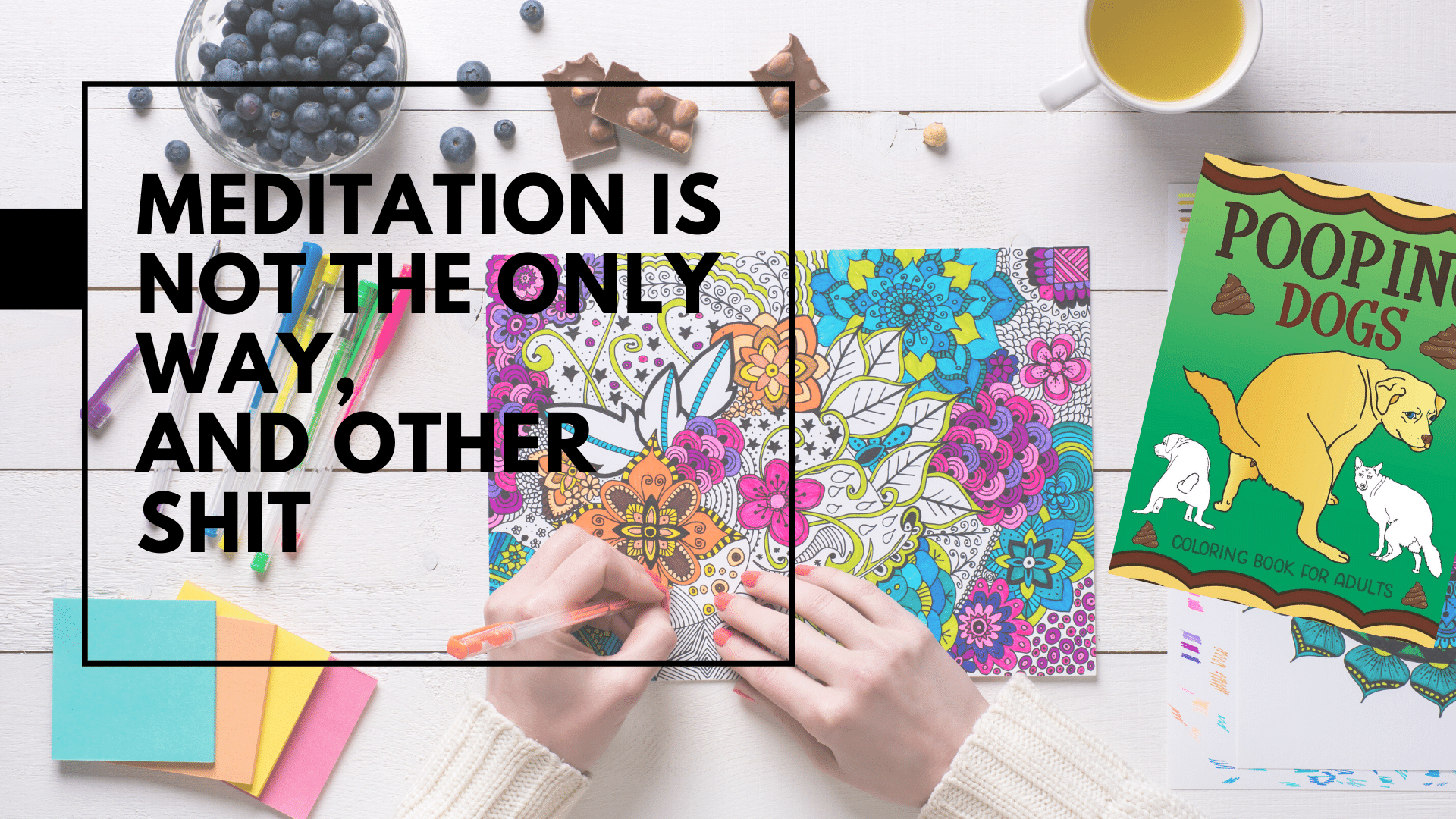
The cool thing is that any conscious practice that fosters the three skills above and that brings your autonomic tone down is meditative in nature. Coloring books? YES! Playing music? YES! Eating? YES! It totally can be, and actually approaching eating as a mindful experience can lead to incredible results --it is just that it is so much harder than it sounds. As long as you are intentionally practicing one of these skills and not performing, it can be a way to “meditate.”
Like any practice though you will need to have a purpose and a long term view of the process. Coloring elaborate pictures of flowers and cupcakes every so often and telling yourself that you are “meditating” is not really going to cut it. You might want to find some guidance. And this does not need to be sophisticated. Even if seated meditation(the one where you stare at shit) is not your thing, you could start there and then develop your own practice. There are so many apps to start that the problem might be choosing one. We are here to help, so if you need a nudge, hit us up. And remember: the most powerful thing you can do is just to start.
Before I forget, let me tell you why we meditate. It is quite simple actually. The ability to accept all the noise from the world as it comes while just focusing on what matters to you is a superpower. If you ever want to manifest who you want to be and there is noise in your inputs, there will be a lot more noise in your outputs. Clarifying the inputs, and the output will create a more fulfilled you. Moreover, the ability to bring yourself to a state of chilling (autonomic state down) without the need of external agents (i.e. drugs/alcohol) means you will be able to actually turn your stressors into growths. Drugs are numbing, not skill-builders; they have a place but this is not it. Always remember that a lowered autonomic state means a more compassionate you, which means a you who can look at reality for what it is and grow.
Now turn your motherfucking phone off, it is time to stare like a weirdo, or color books of turds.
Grow!