
Stay Active
No matter what.
I could drop the mic there and leave. But I will not.
Get this. Your brain does not function as well when you are inactive. You are not as productive and your thinking is not as sharp. I am not talking about being super fit and lifting all the weights and doing all the sports, I am talking about being active, and moving around, physically and mentally.
It took me 12 years of hard academic work to reach this conclusion. I could have reached it faster if I had read the enormous amount of evidence supporting this, but that was not very available to me at the time. I lived in the academic world, where knowledge is partitioned in somewhat closed sets: here are the humanities, here're the sciences, here's economics, and so on. Moreover, in academia, we lived the life of the mind. Caring about your body was considered a little superficial. On the other hand, drinking and smoking, although not exclusively, were considered intellectual activities at some level. When I was a younger grad student in Chicago, the mantra of the divinity school was: drinking and thinking. I lived by that mantra until I couldn't.
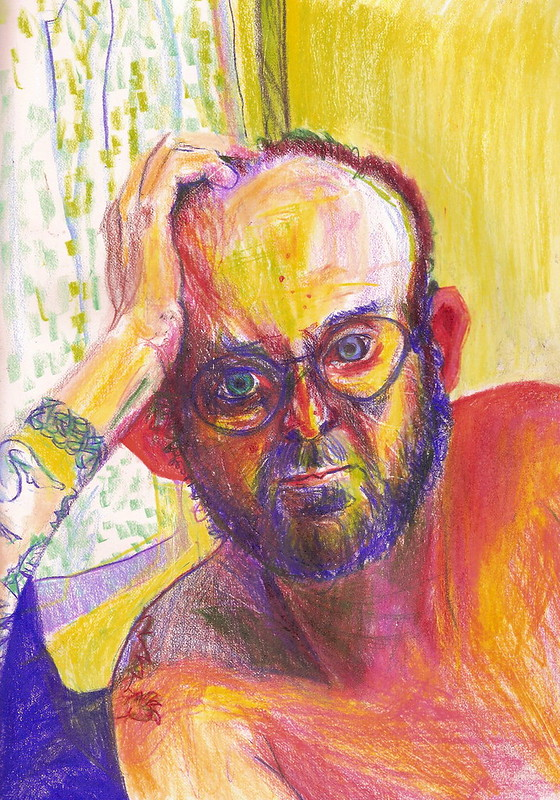
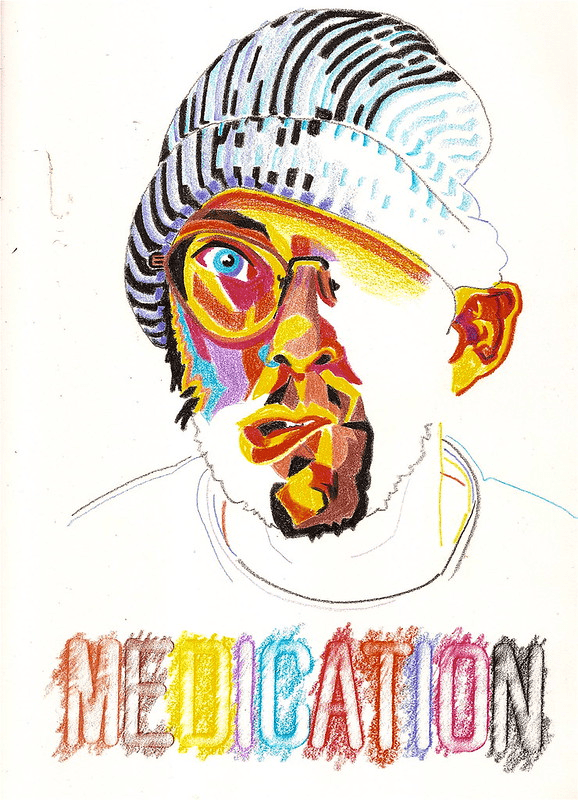
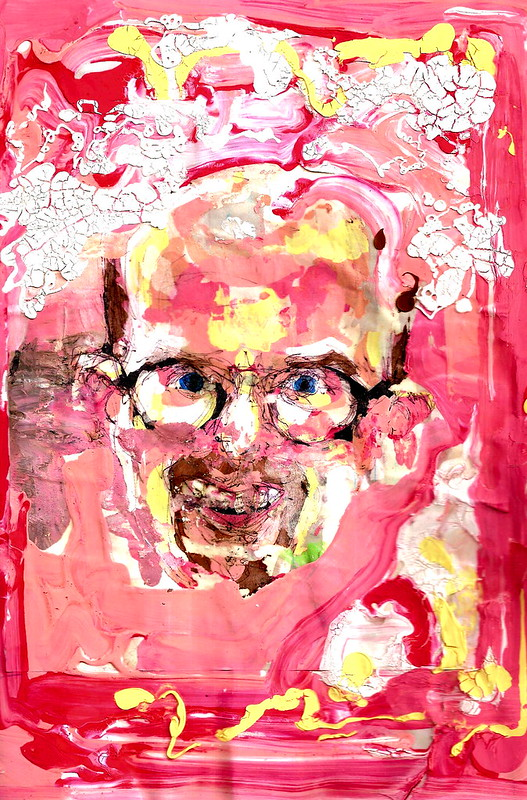
I arrived at that conclusion slowly but surely. One of the last strokes arrived when I came to confront the works of Bryan Lewis which are one of those things that periodically resurfaces on the internet and then dies after a while. Since 1995 he has been producing daily self-portraits. There is one particular series of these drawings that are done while he is on specific drugs.
Here's 10mg of Ambien
And here's Ativan / Haloperidol (doseage unknown in hospital)
Here's 1 "Bump" of Crystalmeth
here's Morphine IV (doseage unknown)
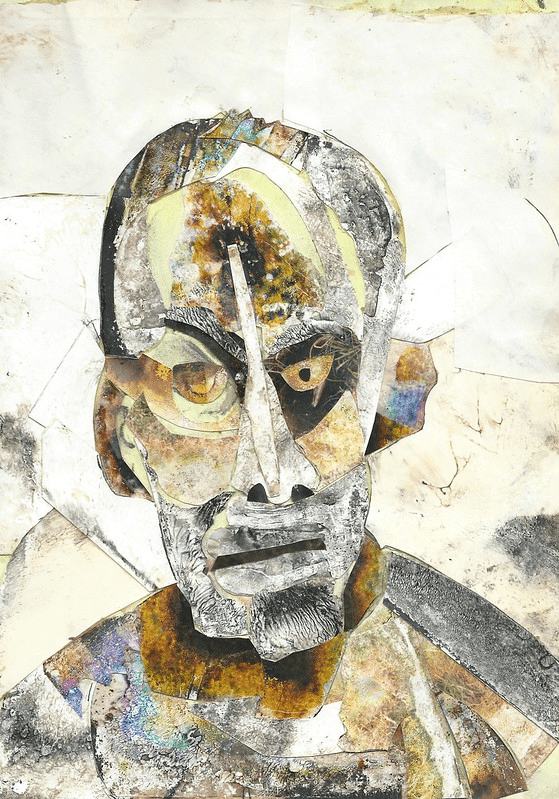
The list goes on and on. It includes 2 bottles of cough syrup, hash, cocaine, marijuana, and a great manifold of drugs whose names I cannot even pronounce.
When I encountered these paintings, the bulb inside me lit up. I had read Huxley in high school, so I knew one of the positive aspects of drugs is that they help you understand experientially that we never fully know reality. What we know is just our perception of it. But I hadn't fully grasped what that meant or implied. In my head, the effect of drugs was something temporal. I got drunk or high, and it was as if I was a different version of myself for a short period of time and then came back to normal. But that was not it. Let me use an analogy I dislike, but that will be effective. When I was a kid, I thought when I was drunk or high, I was changing the software. But that wasn't quite right—I was changing the hardware, and that's what Lewis has been stubbornly showing us all these years. It might sound like a nuance, but nuance is what differentiates an idiot from a smart human. But here's a big conclusion for you:
Our thoughts and ideas are biochemical products. They are the result of chemical and electrical processes, not logical arguments. Words, images, and sounds are not the source of thinking. The source is physical, and it is biological, electrical, and chemical.
KABLOOM!
It took me a while to kick the habits that I had developed and recover a somewhat stable lifestyle. There were many battles and allies involved here, but that's a topic for another email. What matters is that when I was done, I felt like I had recovered my brain, my thinking was sharper, and I felt more like myself. I certainly had to deal with some stuff, and I did. Focusing on good nutrition and good movement was the most powerful experience of my life.
One crucial understanding that came with this process was that of really seeing mind and body as just one thing. This is not how we culturally operate at all. The fact that most still think that taking care of your body is superficial, points to the fact that you think your thoughts are independent of your body, they are absolute, they are the product of reason. They are not. Reason is a biological construct.
Fortunately, we are a little farther away from that. Now we see physical activity and taking care of our body as a healthy thing, which will help us live longer and avoid disease. I think that's a quarter of a step forward. I celebrate it and recognize it, but we have to go further. So I invite you to embrace your body. I invite you to feel grateful for it (regardless of disease or body fat percentage), and I invite you to take good care of it. You and your body are the same things. Thinking is a metabolic process, so make sure your metabolism is sharp AF.
No matter what,
stay active!
PS: I mean active as in physically and intellectually. And also: eat all the good stuff, and protect your sleep. Let biology take care of the rest.