
The Thrive Zone
If you want to get better at your sport/discipline/exercise-routine, approach your training as a time to learn not a time to perform. This mindset shift is one of the most powerful tools in your arsenal. The moment you go to learn and not to perform is the moment you free yourself from chasing immediate results and you accept that every human endeavor is a process, every project a prototype, every person a learner. On the other hand if you go to your training focusing solely on being “better” than yesterday, on getting a particular result, your approach will become binary, your training a grind, and your main achievement dealing with frustration.
In my professional experience, good learners thrive in the gym. The greatest impact and progress I have witnessed among my clients has come to those focused on learning about the discipline I am teaching them, those who are learning about themselves, about their own movement and body. Fortunately, we know that even learning is a skill that can be taught, learned and practiced. The purpose of this post is to tell you how to do it for your fitnessing.
Let’s start by creating a general framework on learning. (WARNING: This is going to get nerdy, so put your glasses on, and be ready to feel sexy 🧐). First, I want to present to you the model of the Zone of Proximal Development (ZPD). This model states that learning happens when the learner spends most of the time practicing skills in which he/she is successful only with the aid of some external support. If you spend most of the time practicing skills in which you are successful without aid, or those in which you are not successful even with help, learning will rarely happen. This model was developed by psychologist Lev Vygotsky early in the twentieth century as product of his careful observation of how children learned.
I think this model provides an excellent framework for your training. The first conclusion is that in your training you want to spend most of your time in your ZPD, which for coolness we will call 💥The Thrive Zone💥. This is where I try to have my athletes all the time, and when I am successful, progress just happens. So our first task is to figure out how to find that zone.
Let me give you an example that should be illuminating. Imagine you ran a 5K race and everything goes your way. You start at an easy pace for the first mile. It is 20 seconds over your target pace, it feels easy. For a second there you panic, “This feels too easy, I am over 20 seconds over my pace, how am I ever going to get under my target pace?” But you remember your plan: this first mile is supposed to feel easy, and so you trust your plan you stay with it. In the second mile shit starts getting rough but you know now is the time to push—it is time to accelerate. “Buckle up, buttercup!” Deep in that second mile, another moment of panic comes, “Am I going to last all the way, I am pushing too hard too early?” But you remember your plan, and the face of your coach, and his nice accent, and you stick with the plan. Third mile comes “Finally!”, you made it, you thought you would not but you did, the confidence boost is enormous, you pass someone and after that nothing will fucking slow you down! You pass as many people as you can, “Look who’s laughing now mdfks!” You finish strong and the fucking world is at your feet.
Epic, right? That was a great performance, but wasn’t in your thrive zone. You worked in your thrive zone in training the months prior, so that on race day you could execute what your body and mind had already learned.
It all started when you decided you wanted to learn, so you wrote down what happened in a training session. By capturing your experience in this way, you were focusing on process, rather than outcome. Over time, this built your trust in the process, and helped you stay consistent in your training. This trust then paid off in those two panic moments on race day when your brain said “You got this sis! Stay with the plan!” and you believed it. Also because the shit you wrote was the info your coach needed to design your workouts with precision. So that when that nice Colombian guy prescribed you four 800 meter runs at 6 minutes per mile he knew you would be successful. He was not pushing you he was just showing you you could. You see, your training was spent doing tasks that you could do with help: the right speeds, the right rest periods, the right strategy, and so on. You were so often in the Thrive Zone in training that when performance day came, you just needed to show up, and you did sis. Hair game on point and all! ‘
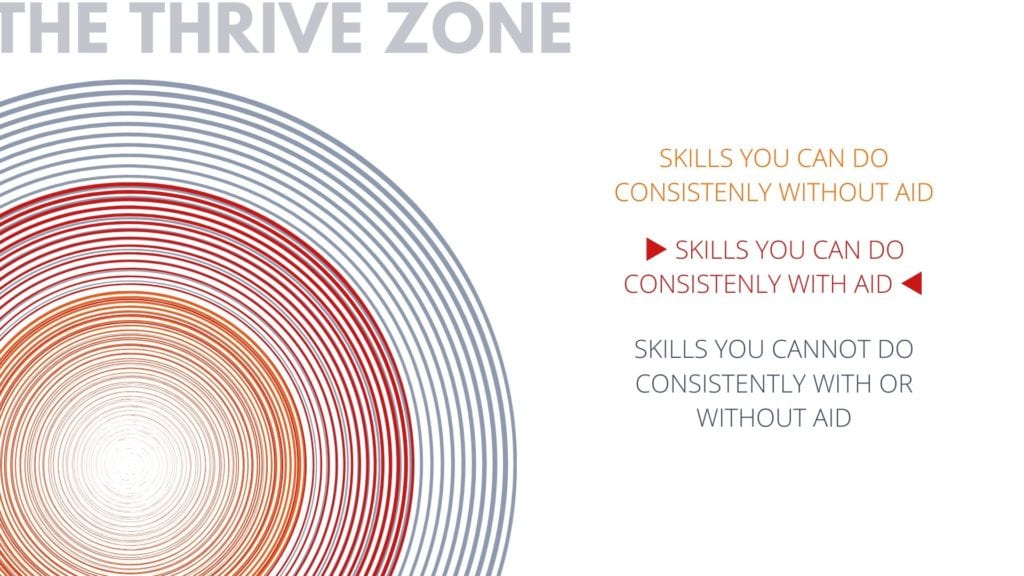
The best way to stay in the Thrive Zone is by having an external mediator or a more experienced teacher with whom you have a positive, trusting relationship. A person that can help you find those intentional exposures of challenge and success. Now even if you don’t have access to a good coach or teacher, you can still do a lot of things to try putting yourself in the right zone. It all starts by having the right mindset.
How to get to the Thrive Zone
- Have a purpose on each training session. Go to the gym with a clear purpose. That could be given to you or you can decide it. This purpose should not be a result. I want to do 15 unbroken pull-ups today, is not a learning experience, is a test. If you can do them perfectly you are not in your thrive zone, if you can’t you will be outside. Going in with I am going to do as many pull-ups as I can keeping my body in a tight position, and recording myself for immediate feedback IS A PURPOSE. You will be successful and your video will be your aid. From this session, you will come to know something new that you can apply the next session. You will also have given the stimulus to your body of pulling with great mechanics. When race day comes, those mechanics will be there for you, no camera needed.
- Differentiate very well where you would like to be, from where you are. I often see this in my gym. A workout is on the board and my athletes will try to do what they would like to be able to do, not what will lead them there. Mia wants to be really strong so she always shoots for a heavier weight. But that just puts her outside her thrive zone. She is choosing her workout load based on where she wants to be and not on what will lead her there. Working at a lower weight but with excellent positioning and more speed/power will allow her to learn. While working at a heavier weight slowly and in poor alignment will not.
- Get help. This could be a camera like in the example above, but it could be a good tempo scheme and a good strategy to deal with it. This could be the eye of a coach, or a mechanical aid to help you with a movement. It could be as simple as putting your ego to the side and using the yoga block for that hard pose. It could be using the bands for the muscle-ups, even though you can do muscle-ups, it is just that with the band you will actually get all the reps needed with way better mechanics (that one is for me). It could be anything! A metronome for your pacing your jump rope, a carefully crafted playlist that would keep you running at your pace, or a recording of your mother telling you how important is to stay present with the task at hand (this is one is also for me).
- Choose an exposure in which you are pretty sure you will be successful. Don’t confuse success with ease, or with lack of progress. I know in my present capacity I can run 800 meters splits at 6 minutes/mile. I also know it will be hard as fuck and I will want to re-evaluate my life after doing it. I would love to be able to do them at 5, but I can’t right now. So I have to train at 6, and push the envelope very little to stay within my Thrive Zone and keep learning, in my mind and in my body.
Keep in mind that this points are valid even if you have access to a good coach or teacher. Your mindset is still the base of your behavior so cure it with love.
Whatever you do, remind yourself: If you intentionally train skills that you own with help, you will learn. Eventually you will not need the aid, which is progress. Now, no need to be perfect, right? Some days you should just perform, and fuck the rest. Some days you should test the waters and see where you are. And some days no matter how much purpose, support or aid, you will fail at life. If your mindset is still that of learning you will still be in the Thrive Zone, that is the beauty of the whole thing. You will win at the end. And it all starts from realizing that training is learning, and that is the best thing you can do to your one gorgeous self. Also make sure your notes are amazing.
LEARN!